Hard Armoring vs Living Shorelines: What the Evidence Shows
Every seawall is a trade. The structure protects the upland; the intertidal zone in front of it loses habitat, and the shoreline on either side changes. For Galveston owners the useful question is not whether to build, but what the current evidence says each option protects — and what it removes.
What the science says about armour
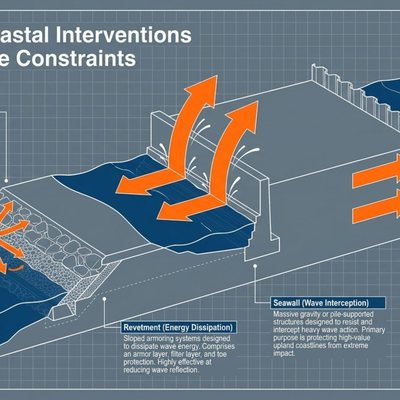
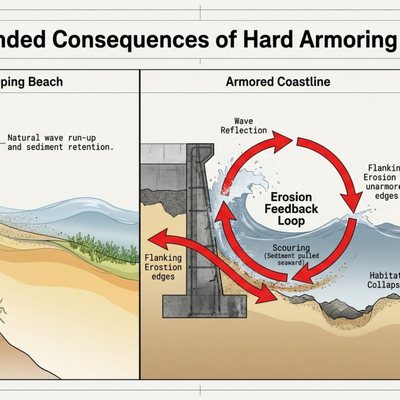
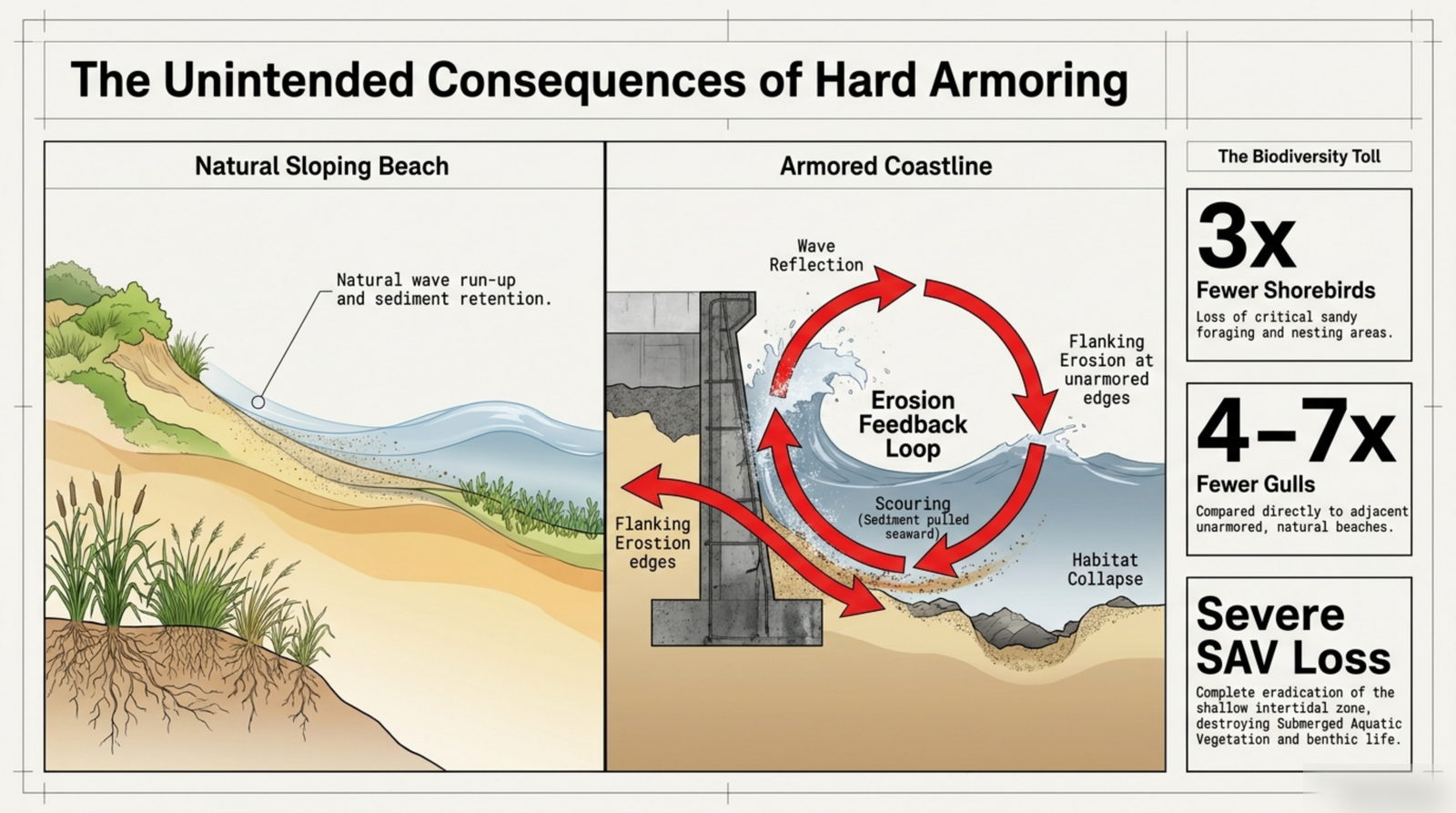
Walls protect the land behind them, and they change the beach in front of them. The USGS Puget Sound armouring study measured the difference directly: compared with unarmoured segments, armoured shorelines supported significantly less habitat area, lower macrophyte wrack biomass and fewer invertebrates, and foraging shorebirds and roosting birds — including gulls — responded with significantly lower species richness and abundance on the armoured segments (USGS SIR 2010-5254, ch. 19).
That is not an argument against building anything; it is an argument for knowing what you are trading, and for choosing a design that keeps some of the habitat function.
The nature-based baseline: marsh, dune and sand
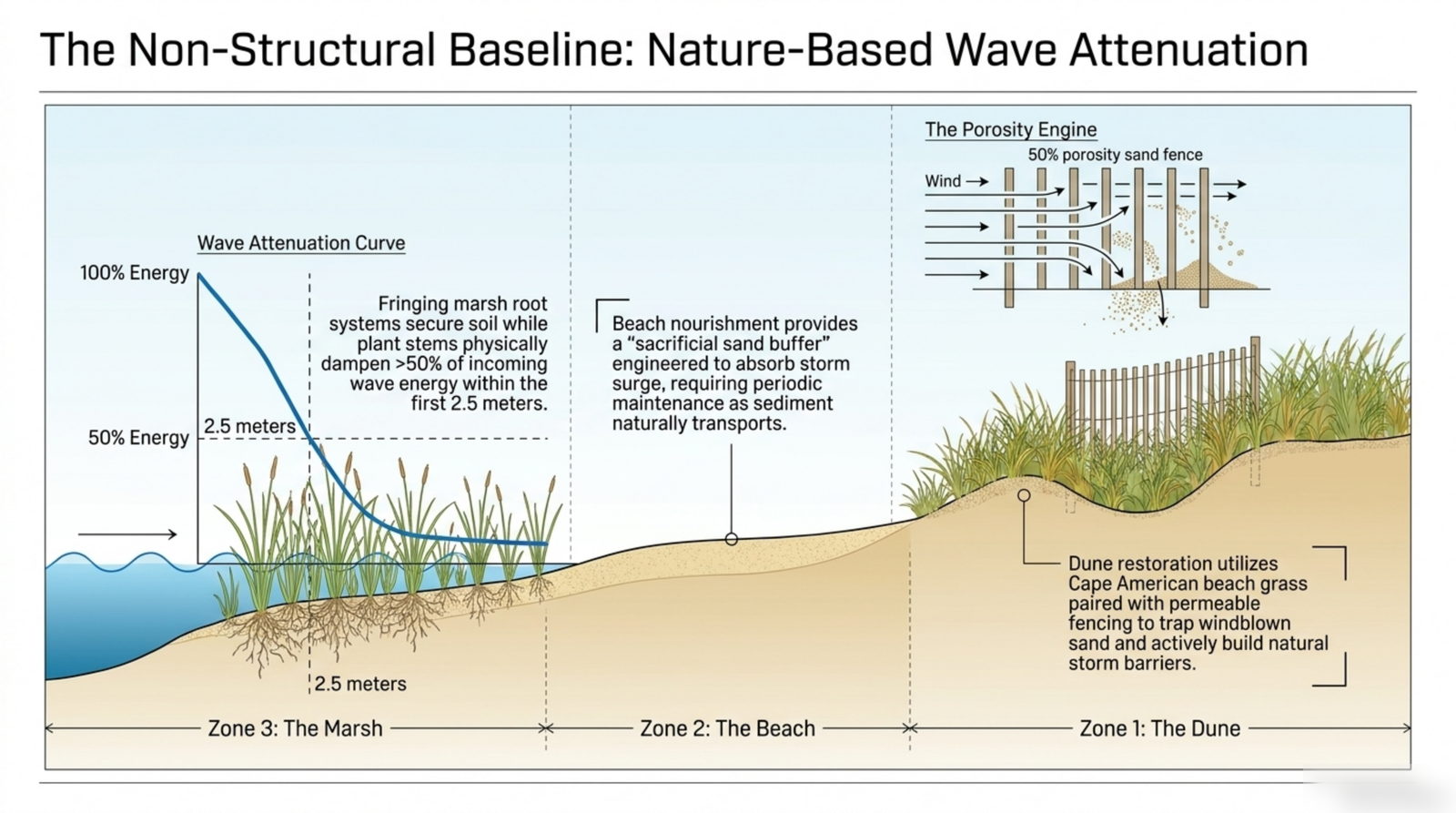
Vegetated shorelines attenuate wave energy themselves. A flume study with natural marsh found that up to 60% of the observed wave-height reduction was attributable to the presence of vegetation (Möller et al. 2014, as summarised in Castagno et al. 2021). Root and stem structures slow the flow, trap sediment and let the shoreline build vertically.
On sandy shores the equivalents are a sacrificial sand buffer (beach nourishment) and dune restoration — dune grass to hold the sand, plus permeable sand fencing to trap it while plants establish. These measures are cheap per metre and self-healing, but they are also the first things to go in a major storm.
The hybrid approach: structure where it is needed, habitat where it is possible
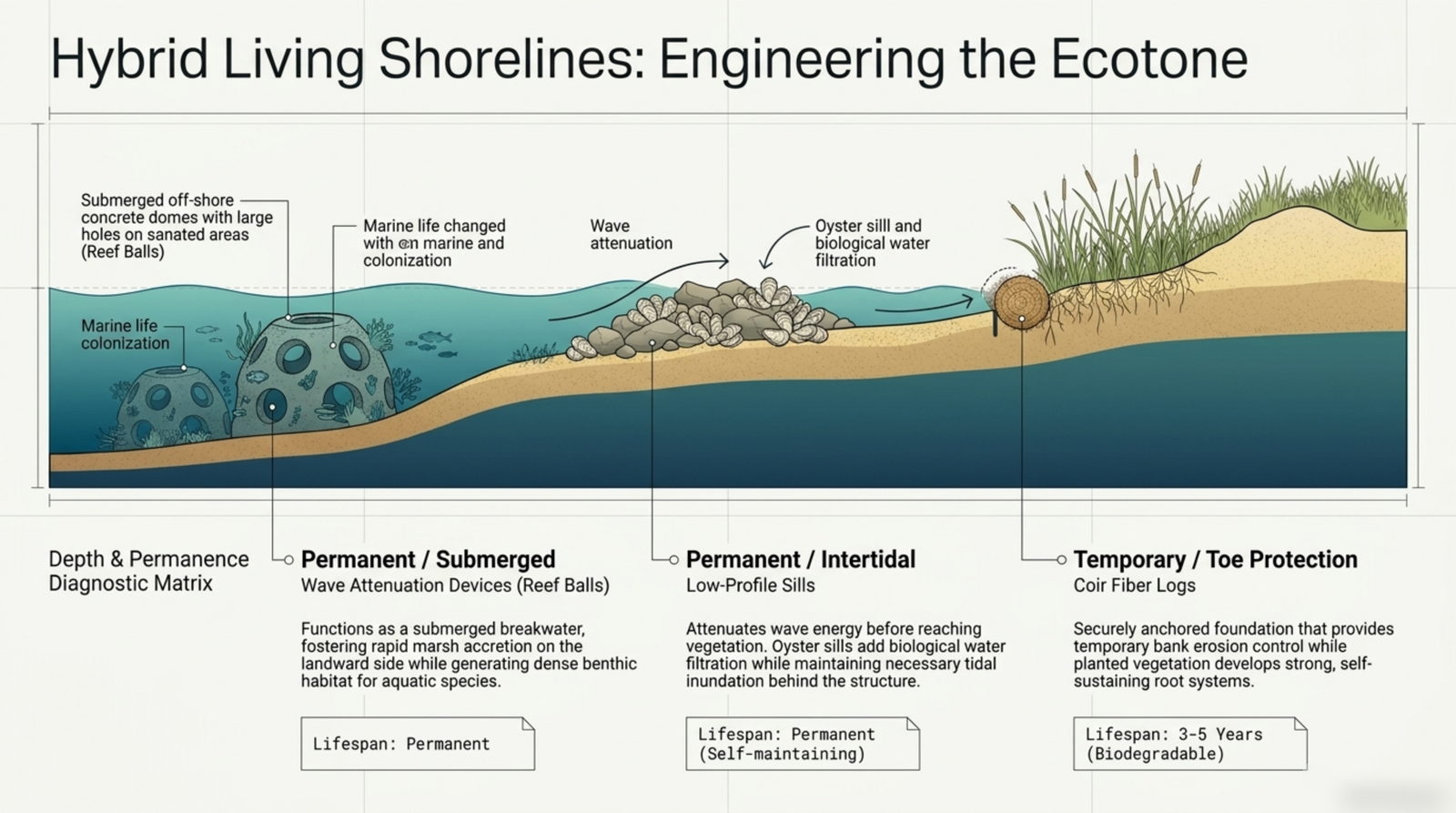
Living shoreline designs deliberately combine both: a low-profile rock sill offshore with marsh planted behind it, reef structures that cut wave energy while creating habitat, and temporary stabilisation — coir fibre logs, for example, whose useful life is measured in a few years while vegetation establishes behind them.
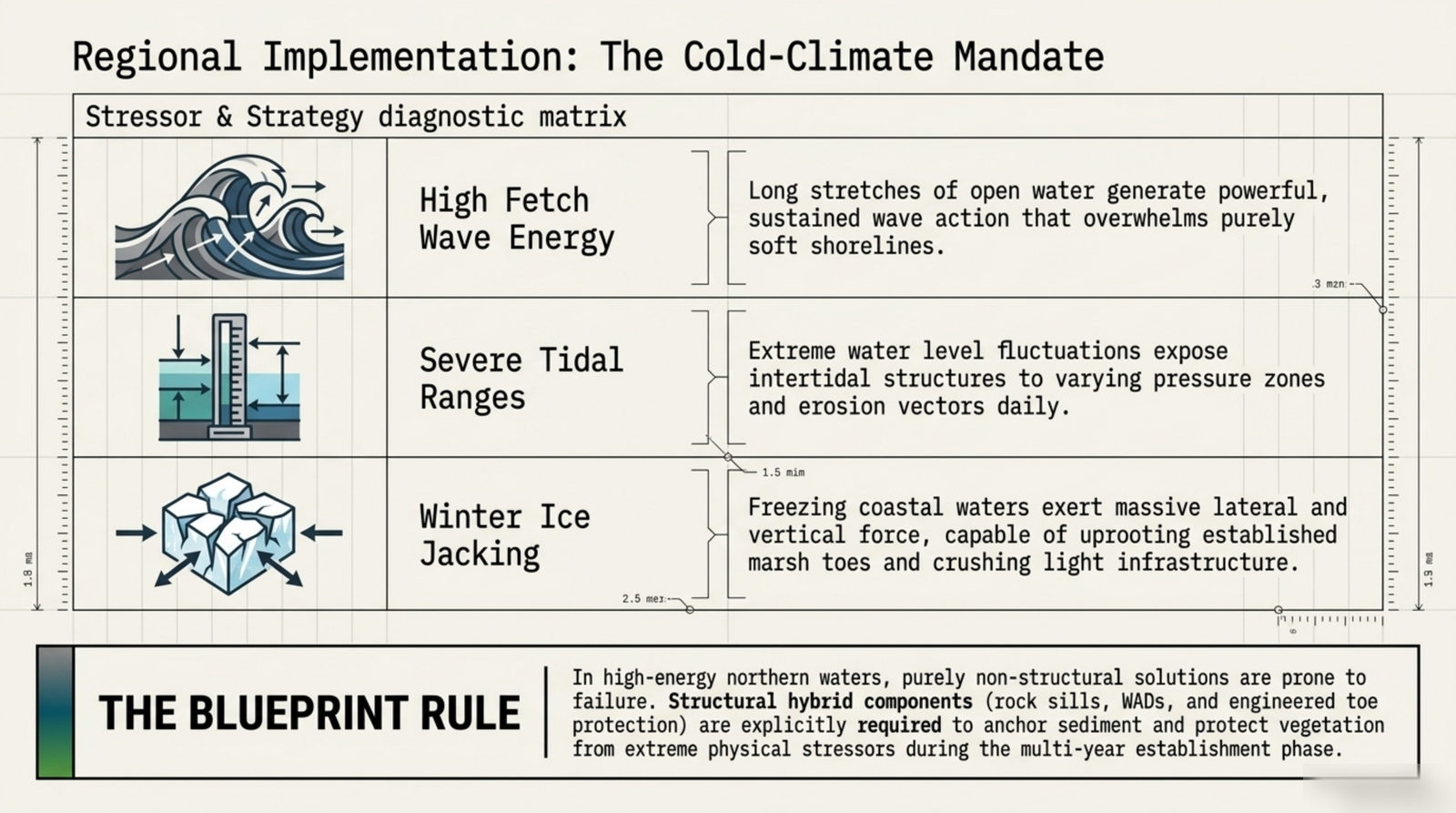
The engineering question is where a purely natural approach stops being enough: high wave energy, large tidal range and ice action are the conditions that push designs toward the structural end of the spectrum, because vegetation cannot establish if the substrate is being washed out from under it.
Retrofitting a wall you already have
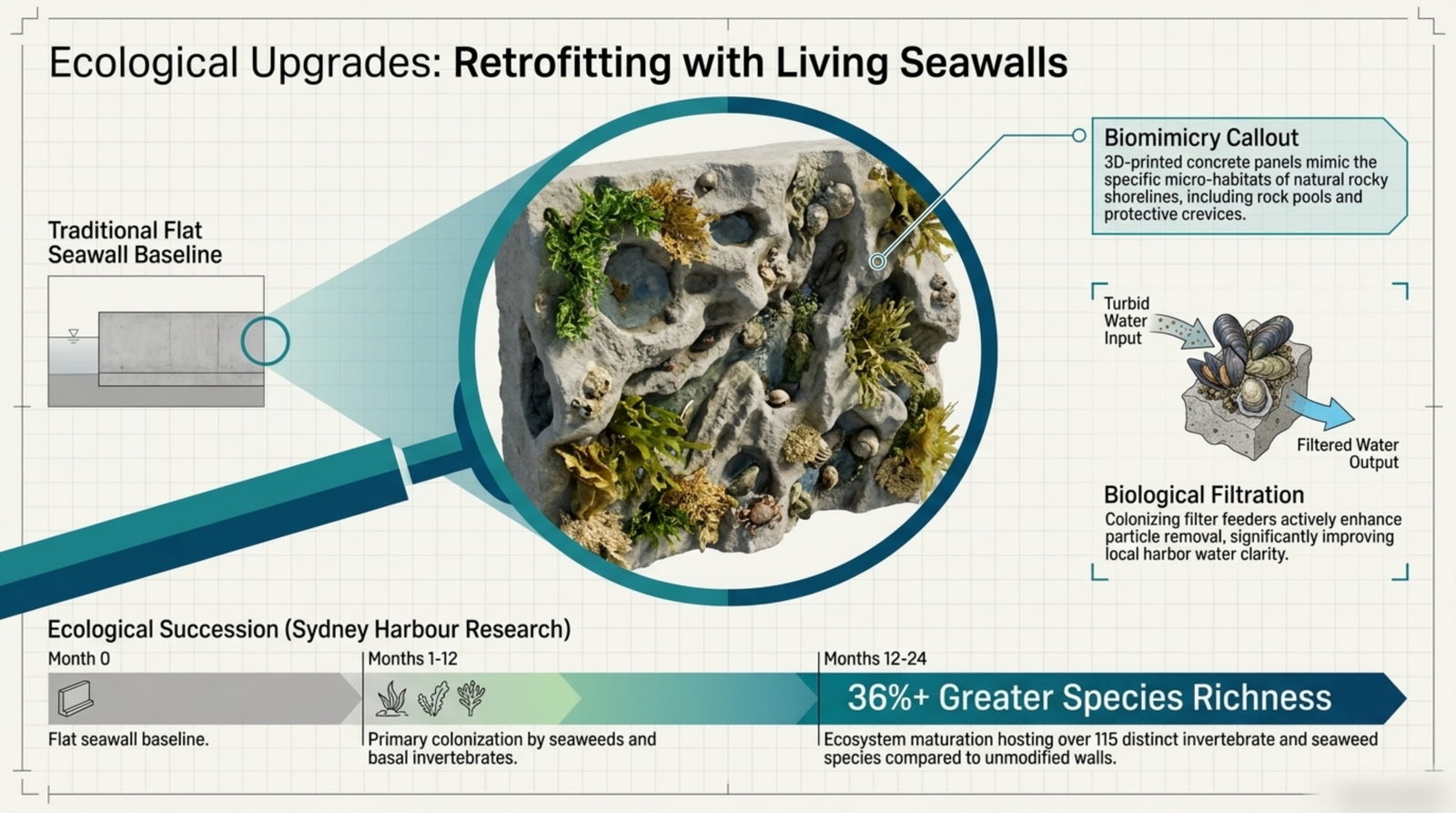
If a wall is structurally sound, the ecological damage does not have to be permanent. Habitat panels retrofitted to existing seawalls — textured, complex surfaces that mimic natural rock pools — have been monitored in Sydney Harbour for two years: 43% to 264% more species were recorded on the habitat panels than on flat control panels, with 115 species observed across the panels in total (25 algae, 48 mobile invertebrates and 42 sessile invertebrates), some panels reaching biodiversity comparable to natural rocky shores (North Sydney Council monitoring summary, 2022).
For a homeowner this is a retrofit decision rather than a rebuild decision — and one worth discussing at the same time as any repair, since the panel cost is far smaller than the wall itself.
What this changes about your next quote
Ask any contractor for the trade-off explicitly: what does the structural option protect, what does it remove, and is there a hybrid variant — sloped armour with vegetation, a sill with marsh behind it, or a habitat retrofit — that meets the same wave design at a similar cost.
Where shorelines are low-energy, tidal or marsh-backed, the hybrid answer is often the cheaper one over 30 years, which is exactly what our 30-year cost comparison tool shows. Where the site faces high open-water energy, the structure has to lead and the habitat measures follow it.
Sources
- USGS SIR 2010-5254 ch.19, Ecological Effects of Coastal Armoring (Dugan & Hubbard)
- Castagno et al. 2021, Front. Mar. Sci. 8:756670 (citing Moeller et al. 2014 flume study)
- North Sydney Council — Living Seawalls panel monitoring, Sydney Harbour (2022)
Every figure quoted above is traceable to the sources listed; where a claim could not be verified it was left out. Links accessed 12 September 2026.
Need a Galveston pro to look at your wall? Call (832) 852-0497 for a free, no-obligation quote from a pre-vetted local seawall contractor.